Greaton Steel Bed Frames Built for Real Use
Greaton's bed frame line covers three distinct setups: a canoe-clip queen frame for traditional box spring use, a twin extension-glide frame for tight rooms and growing kids, and a 14-inch foldable platform frame for anyone skipping the box spring entirely. All three use re-rolled rail steel or solid steel construction — not stamped sheet metal — and are designed to stay quiet under nightly use.

Three Frames, Three Different Jobs
Advanced Steel Bed Frame Queen
See on Amazon
Advanced Steel Bed Frame Twin
See on Amazon
Foldable Platform Bed Frame Twin
See on AmazonFrame Specs Side by Side
Each frame in this line has a different footprint, height, and compatibility profile. The table below lays out the specs that actually matter for fit decisions.
| Model | Dimensions (L×W×H) | Frame Height | Weight | Box Spring Needed | Key Construction Features | Best For |
|---|---|---|---|---|---|---|
| Advanced Bed Frame — Queen (BFgt-Q) | 80" × 60" × 7" | 7 inches | Not specified | Works with box spring; squeak-resistant | Re-rolled rail steel, canoe clips, double-riveted 5-leg center support | Standard queen setup with box spring; heavier mattress loads; primary bedroom replacement |
| Advanced Steel Frame — Twin (BFgt-T) | 74" × 38" × 7" | 7 inches | Not specified | No box spring needed | Re-rolled rail steel, extension glide, canoe clips, double-riveted steel legs | Single sleepers, kids' rooms, tight spaces; works with or without box spring |
| 14-Inch Foldable Platform — Twin (MPBg-3/3) | 75" × 39" × 14" | 14 inches | 25 lbs | No box spring needed | Sturdy steel, foldable, tool-free setup, grey finish | Foam or hybrid mattresses; under-bed storage; apartments with tight stairwells; frequent movers |
If you're using a box spring, the queen or twin rail frames are the correct fit; if you're going mattress-only and want storage clearance, the 14-inch foldable platform is the one to choose.
Picking the Right Frame for Your Setup
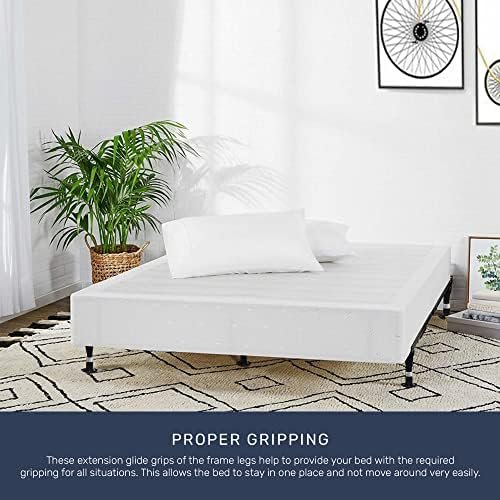
The most important split in this line is between the two traditional-rail frames (queen and twin) and the 14-inch foldable platform. The traditional frames are designed to work with a box spring and mattress — they sit at 7 inches of rail height, which is standard for most box spring setups. If you already own a box spring or plan to use one, either of those frames is the right starting point. If you're going mattress-only — foam, hybrid, or innerspring on slats — the 14-inch foldable platform is the better fit, and the taller profile gives you real under-bed storage clearance.
Within the two rail frames, the decision comes down to size and room configuration. The queen frame (80" × 60" footprint) is built for a standard queen mattress and includes canoe clips to lock cross arms in place and double-riveted 5-leg center support — the center leg is what separates a frame that holds up over time from one that develops a bow in the middle. The twin extension-glide frame (74" × 38") is designed for tighter spaces and single-sleeper setups, with extension glides that allow small position adjustments without disassembling the whole frame. It also carries the "no box spring needed" spec, which means it works with a mattress placed directly on the rails.
- Using a box spring: Queen or twin rail frames — both are built for that configuration.
- Going mattress-only with storage underneath: 14-inch foldable platform frame — 14 inches of clearance is enough for bins, seasonal gear, or a trundle setup in a kid's room.
- Small room or studio: The foldable platform frame assembles without tools, which also makes it the practical call for anyone moving frequently.
- Queen with center support priority: The queen rail frame's double-riveted 5-leg design handles heavier mattresses and shared-weight setups better than a 3- or 4-leg configuration.
How These Frames Work in Real Rooms
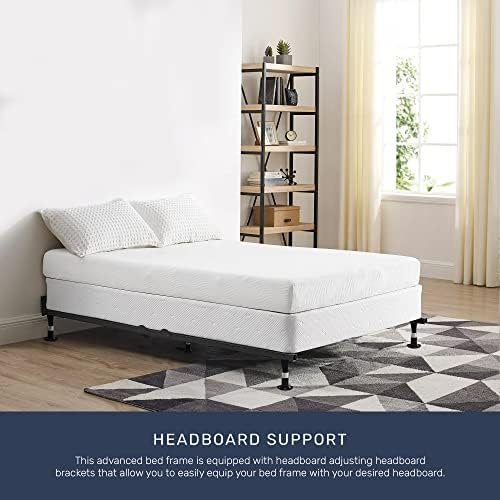
The two 7-inch rail frames are a natural match for anyone setting up or replacing a traditional bed — box spring on the frame, mattress on top, total profile determined by what's stacked. The canoe clips on both frames do a specific job: they prevent the cross arms from shifting when weight shifts on the mattress. That's the failure point on cheaper frames — arms drift, the mattress follows, and the frame starts creaking. The riveted construction on the legs serves the same purpose; loose hardware is where frame noise starts.
The 14-inch foldable platform frame is a different use case. At 14 inches, it sits notably taller than the rail frames — that's by design, because the platform replaces the box spring and needs to put the sleeping surface at a practical height without one. At 25 pounds and tool-free assembly, it's also the right frame for apartments with narrow stairwells or for rooms that get rearranged. The grey finish fits most standard bedroom setups without reading as industrial.
A few real-room scenarios worth naming:
- Guest room on a budget: The twin extension-glide frame paired with a bunkie board or thin mattress keeps the setup low-profile and easy to move when the room serves double duty.
- Primary bedroom with a foam mattress: The 14-inch platform provides solid, even support for foam and hybrid mattresses that can't use a traditional box spring — and the storage clearance is a practical bonus in smaller bedrooms.
- Replacing a worn queen frame: The queen rail frame is a direct swap — standard dimensions, standard box spring compatibility, and a center support system that handles the weight a queen setup actually puts on a frame.
Keeping Steel Frames Quiet and Stable Long Term
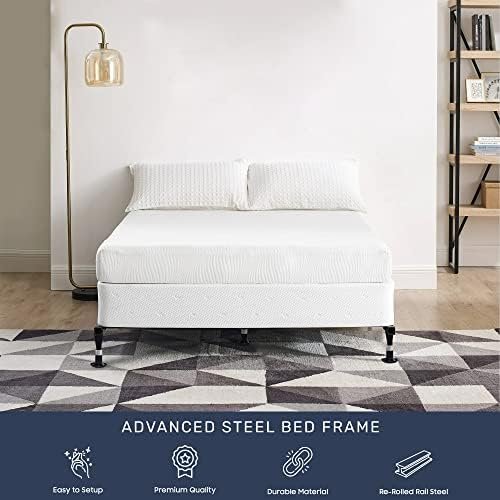
Steel bed frames are low-maintenance, but the most common problems — creaking, shifting, and eventual instability — almost all trace back to the same source: fasteners and connection points that weren't fully secured at setup or that loosened over time. Both the queen and twin rail frames use riveted construction specifically to reduce this. Rivets don't back out the way screws do. But the cross arm canoe clips still need to be fully engaged at assembly — a clip that's only half-seated will start migrating under load within weeks.
For the 14-inch foldable platform frame, the tool-free design means assembly is fast, but it's worth checking every locking point before putting weight on it the first time. "Tool-free" doesn't mean you can skip the confirmation step. Once it's set, it's stable — but that first-use check matters.
- Periodic check: Every few months, verify that cross arm clips are fully seated and that the center legs haven't shifted out of their locked position.
- Carpet vs. hardwood: On hardwood or tile, add furniture pads or rubber feet to the leg bases — this prevents the frame from walking under motion and also protects the floor finish.
- Moving the frame: Disassemble the rail frames rather than sliding them. The re-rolled rail steel is strong under vertical load but not designed for lateral stress against door frames or walls during a drag-and-haul move.
- Weight distribution: The queen frame's 5-leg design is there to prevent center sag, but it works best when the mattress weight is centered — don't store heavy items on the mattress surface unsupported at the edges.
Frequently Asked Questions
Do the queen and twin rail frames require a box spring, or can I use them with just a mattress?
The queen frame is designed around a box spring and mattress stack — the 7-inch rail height is set for that configuration. The twin rail frame carries a "no box spring needed" spec, which means it's built to support a mattress directly on the rails. If you want to skip the box spring on the queen, the 14-inch foldable platform frame is the better option — it's designed specifically for mattress-only setups and gives you 14 inches of clearance underneath.
What does "re-rolled rail steel" actually mean, and why does it matter?
Re-rolled rail steel refers to a manufacturing process where the steel is rolled to a tighter, more uniform cross-section than standard stamped sheet metal. The practical result is a rail that handles weight load and flexion better over time — less tendency to develop a bow or torque under a heavy mattress and regular use. It's the same structural principle behind why I-beams outperform flat plate in load applications. For a bed frame, it's the difference between a rail that holds its shape for years and one that gradually gives under the center.
What are canoe clips, and do they actually prevent the frame from creaking?
Canoe clips are the connectors that lock the cross arms — the horizontal bars that span the width of the frame — to the side rails. Standard frames often use simple hook-and-slot connections that can shift under load, which is where frame creak typically originates. Canoe clips lock the cross arm in place so it can't migrate. Combined with the riveted leg construction (which prevents the hardware from backing out over time), this is the specific design approach Greaton uses to address noise. The queen frame also carries a "squeak resistant" feature designation in its specs.
Can the 14-inch foldable platform frame actually be assembled without any tools?
Yes — the tool-free setup claim is accurate. The frame uses locking mechanisms rather than bolt-and-nut assembly. That said, tool-free doesn't mean skip-the-verification. Before loading it with a mattress and body weight for the first time, go through every locking point and confirm it's fully seated. A connection point that's 90% engaged feels secure until it isn't. Once confirmed, the frame is stable and the 25-pound weight makes it practical to fold, move, or store as needed.
The twin rail frame is listed at 74 inches long, but a standard twin mattress is 75 inches. Will that cause a problem?
The 74-inch length on the twin extension-glide frame refers to the outer rail dimension. The extension glide feature — adjustable position slides built into the frame — allows the usable sleep surface to accommodate a standard 75-inch twin mattress. Measure your mattress and confirm the fit before ordering; if your mattress is on the shorter end of the twin spec, you'll be fine. The extension glide is specifically there to address the fit variation that comes up in standard twin setups.
Is the 14-inch platform frame the right choice for a heavy foam mattress, or will the steel sag over time?
The 14-inch platform frame is built for mattress-only use, including foam and hybrid mattresses. The steel platform construction distributes weight across the full surface rather than concentrating it on rail contact points. For a foam mattress specifically, even weight distribution matters — uneven support is what causes foam to develop permanent impressions. The foldable design doesn't compromise that; the frame locks into a rigid configuration when assembled. At 25 pounds, it's not a heavyweight commercial frame, but for a twin setup with a standard foam mattress, the construction is appropriate for the load.